
Bellingham Math Tutor
How to learn math with DEPTH
The way we tend to teach math in this country is a tiny bit insane. If you are in 3rd grade, we expect you to learn 3rd grade math. If you are in Algebra 2, we'll teach you Algebra 2.
But, as I am sure you are aware, not everyone learns math at the same pace. Even if they did, not everyone remembers the math that they once "learned". In any given class, you will have 30 different students, each with a very, very different math foundation.
Imagine if we taught swimming the way we teach math.
"Welcome to 4th grade swim lessons! This year we'll be learning the backstroke and treading water. What's that? You haven't learned how to float yet? Practice these backstroke exercises anyway, there's a test on Tuesday!"
Sadly, we've got pools full of kids drowning in their math classes at school. This happens ALL THE TIME with math. No wonder kids hate it. No wonder kids struggle. Solving this problem systemically is not going to happen any time soon, but YOU can take charge of your own ability to actually learn math, and learn it DEEPLY.
You will need these 5 things:
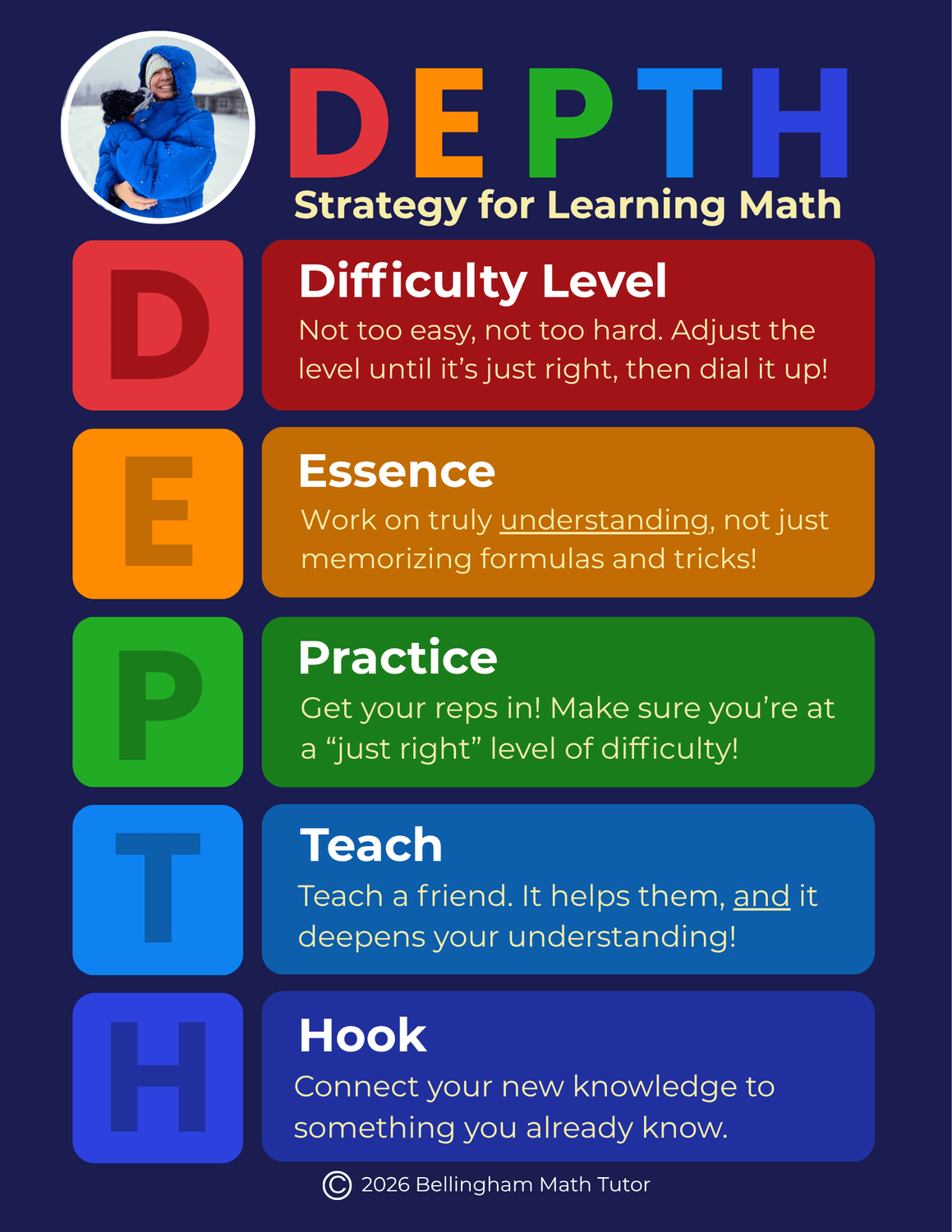
First, and most important, you must dial in your "just right" difficulty level. Anything too easy will be too boring and won't grow any new neurons anyway. Anything too hard will be impossibly frustrating. Find a level that is just challenging enough, and build up from there!
Second, you must actually understand the essence of the skill you are learning. Formulas and memory tricks only work for a little while, and don't help build the necessary conceptual understanding for the skill to help you later on, when the difficulty level increases.
Third, PRACTICE, PRACTICE, PRACTICE! Math is a skill just like swimming, gymnastics, soccer, violin, ballet, guitar, pickleball, etc. If you just watch someone else do these skills, you will never learn to do them yourself.
YOU MUST PRACTICE!! A LOT!!
Fourth, if you really want to learn a concept deeply, teach it to someone else. To teach it well, you have to really understand it. Make sure not to just tell them how to do it, or give them any tricks or formulas! Really explain WHY the concept makes sense!
And finally, to transfer these new skills to the long-term memory section of your brain, you'll need to hook your new knowledge to something you already know. For example, if you just learned that a triangle is a 3-sided polygon, you might hook that new concept to an image of shiny red 3-wheeled tricycle. To really make it stick, draw a quick stick-figure story about it!
Be sure to send us your sticky stick-figure stories! Millie and I love them!
Good luck, and give it a try!

Sign up for our newsletter!
We'll let you know about our upcoming training programs so you can learn to love math again.
Unsubscribe at anytime.


Jill@BellinghamMathTutor.com
Created with © systeme.io
Privacy policy | Terms of use | Cookies